Compliance
Embeds KYT, AML, and the Travel Rule into wallet operations — regulatory response runs inside the transaction flow from the design stage on.
- 130+
- Chains covered
- 10,000+
- Service attribution database
- Real time
- Threat-label feed
- Travel Rule
- Korean exchange labels
Monitoring

KYT — know your transaction
Check the destination's risk before withdrawal. Sanctioned entities, hacked funds, and darkmarket-linked addresses are managed as blocklists.

AML — anomaly detection
Structuring, circuitous routing, and off-hours patterns are judged by rules and scores together, with findings exportable straight into reporting formats.

STR — suspicious activity reporting
Detection does not end at detection. Flagged transactions are compiled into the required format, with reviewer sign-off and submission history stored alongside. The evidence and the report stay connected on one screen, so the decision can be defended after the fact.

Travel Rule
Handles the obligation to exchange originator and beneficiary data between VASPs, interoperating with domestic and international Travel Rule networks.
Capabilities
Multi-chain tracing
BTC, ETH, TRX, and SOL are analysed on one platform, with cross-chain bridges and layering linked and followed through.
Service attribution
An attribution database of exchanges, mixers, and darknet services identifies what an anonymous address actually is — Korean exchange data included.
Threat intelligence lookup
Hack, fraud, and sanctions (OFAC) labels are queried in real time, backed by tracing data on real hacking groups.
Conversational AI investigation
Natural-language instructions carry an investigation from deeper tracing through to the report.
Fund-flow visualisation
An interactive graph, same-owner clustering, and filters for the paths into exchanges.
Reports ready for submission
The summary, address table, laundering techniques, exchanges passed through, and recommended actions are generated automatically.
Risk screening API
A REST API connects directly to the institution's FDS and AML systems, screening in real time before a withdrawal.
Automatic laundering-pattern detection
Sweep, peel chain, multi-output peel, and layering are identified automatically.
From Real-Time Investigation to the Report
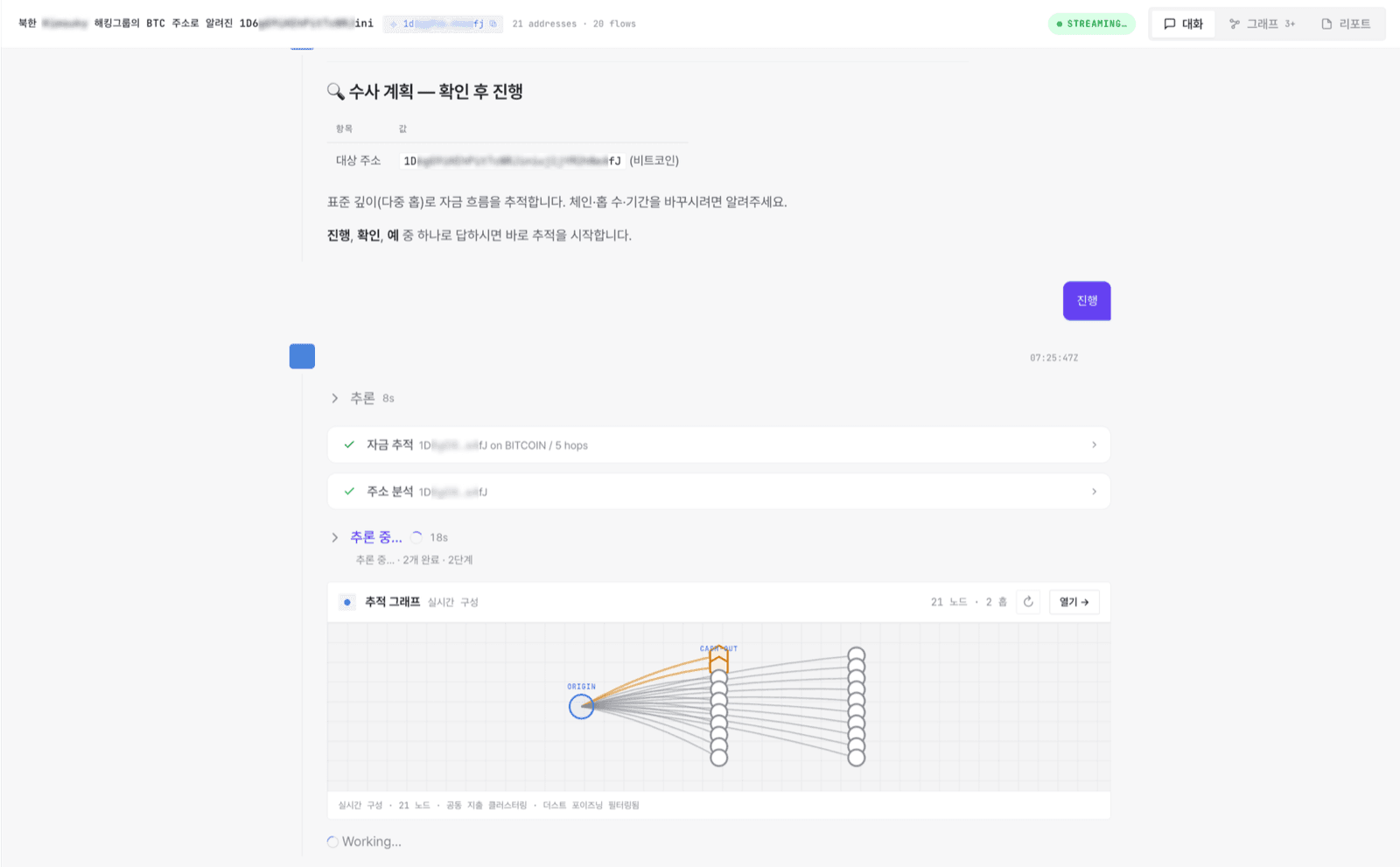
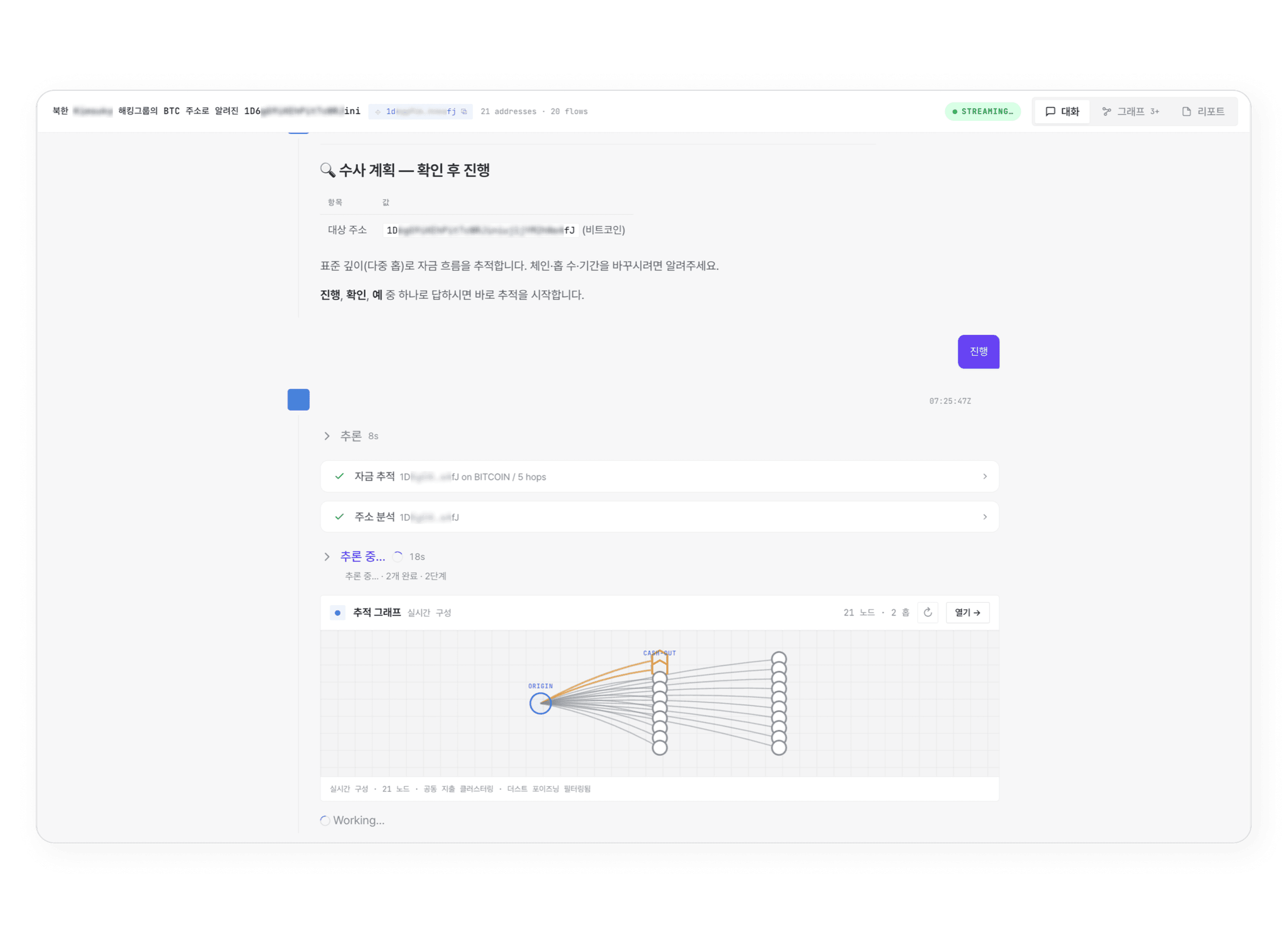
Real-time AI investigation
The AI presents an investigation plan and waits for the analyst to confirm before tracing begins. As the trace runs, the reasoning steps and the fund-flow graph are drawn alongside it in real time.
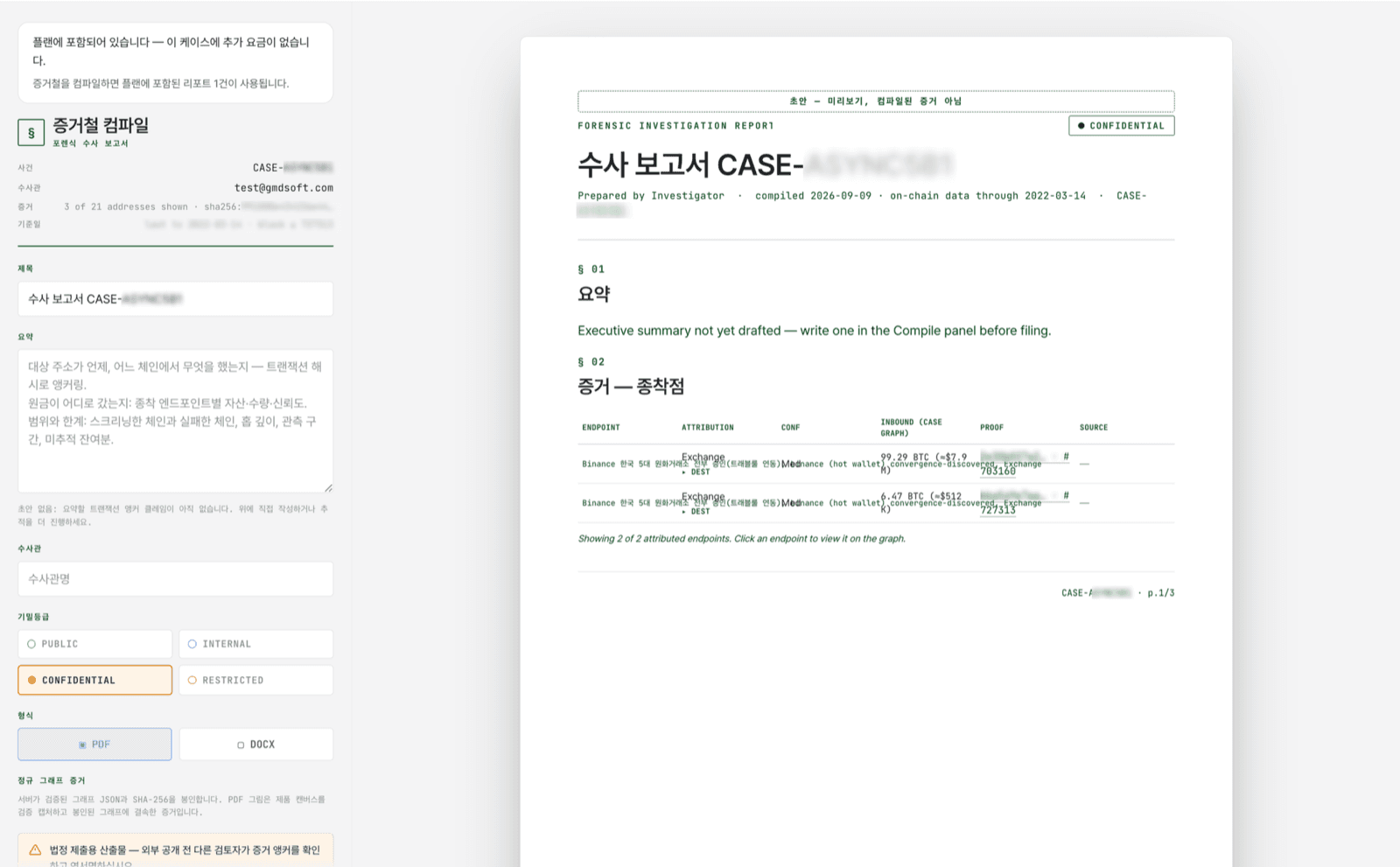
Tracing and report generation
Findings are generated as a report in the required format. The analysis carries through as-is, so it is ready for submission to the regulator and for internal audit.
Obligations by Regulation
Scroll sideways to reach the What Compliance covers column.
| Regulation | Obligation | What Compliance covers |
|---|---|---|
| Telecommunications Fraud Damage Refund ActAmended, effective 1 Oct 2026 | Handling suspension and refund procedures for defrauded virtual assets, establishing the reference point in time, and cooperating with other operators | Automatic path tracing, identification of the wallets and exchanges used, and a report evidencing the basis and timing for a suspension |
| Act on Reporting and Use of Certain Financial Transaction InformationKnown as the Specific Financial Information Act | STR and CTR filing, CDD and EDD, Travel Rule, and money-laundering risk assessment of partner exchanges | On-chain evidence generated for STR attachments, verification of reported wallets, and periodic exchange reviews |
| Virtual Asset User Protection ActEffective Jul 2024 | Acting as the custodian of user deposits and managing the risk that comes with entering the ecosystem | On-chain soundness monitoring of the exchanges holding those deposits, catching irregular flows early |
| Electronic Financial Transactions Act and liability-sharing standardVoluntary compensation, from Jan 2024 | Building an incident-prevention regime, compensating 20–50% where at fault, and preparing for no-fault liability | Fast tracing to maximise recovery — reducing compensation exposure and evidencing the duty of care |
| Forthcoming rulesCorporate accounts, custody, stablecoins | Screening corporate accounts, controlling assets held in custody, and monitoring stablecoin circulation | Deposit and withdrawal screening, issuance and circulation monitoring, and a risk API — the infrastructure secured ahead of the new business |
Digital Asset Infrastructure That Fits Your Business, Start with ABC
Tell us your requirements and deployment constraints, and we'll propose a fit.