AI Agent Payment
Built on the open x402 payment standard: merchants, PGs, and VANs receive agent-initiated stablecoin payments, and fintechs delegate and govern user authority to agents.
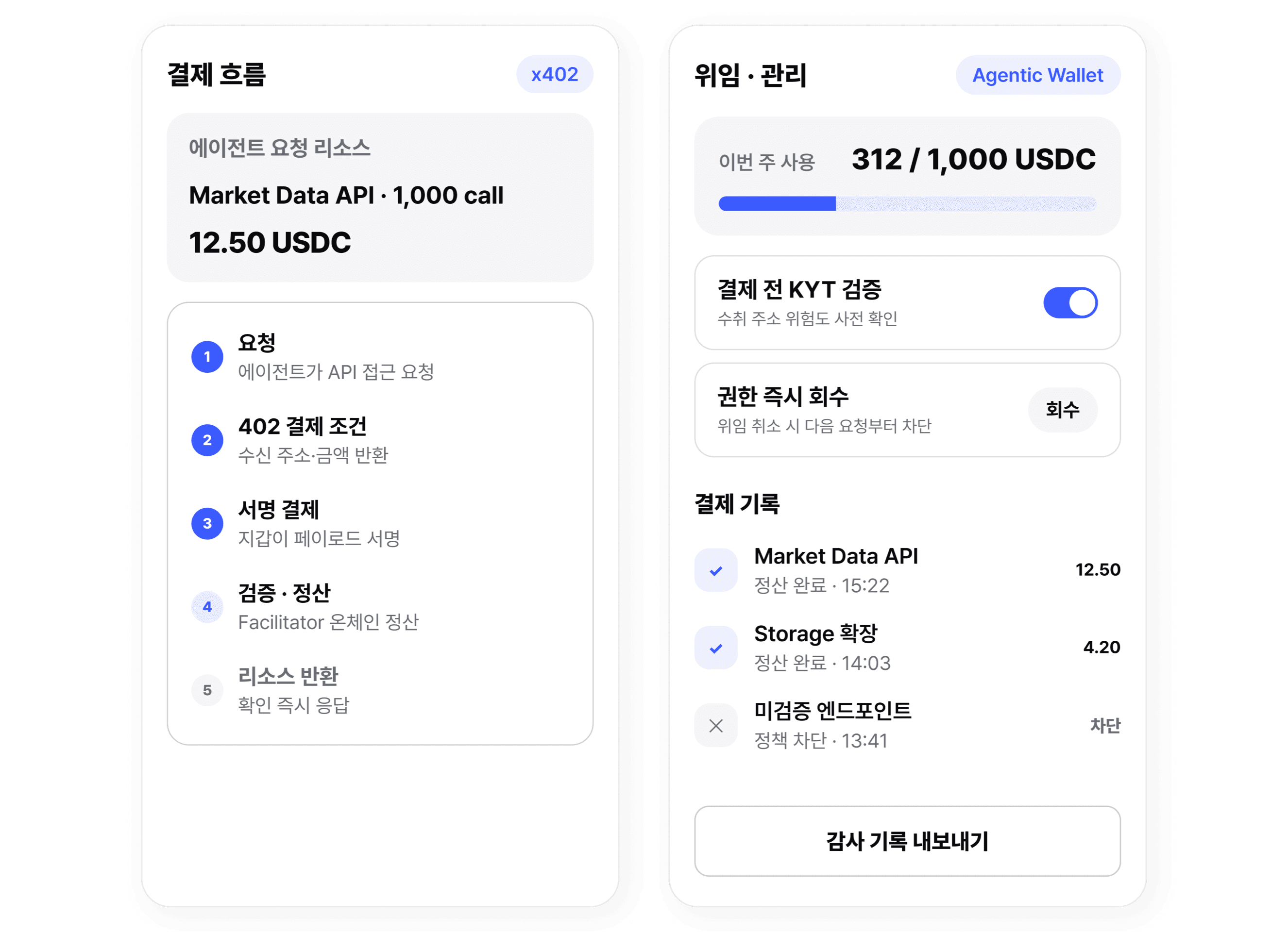
Who Takes Part
- ClientAI agent or app
- Resource serverAPI or content
- FacilitatorVerification and settlement
- Blockchain
How It Applies

Agentic Payments Gateway
Merchants, PGs, and VANs receive agent-initiated stablecoin payments safely.
- Policy control with pre-transaction KYT and Travel Rule checks
- Gasless payments via EIP-3009, so the user never funds gas
- An unbroken audit trail from request to settlement

Agentic Wallets
Fintechs delegate user authority to an agent and operate that wallet safely.
- MPC-based private key management
- A spending policy engine for amount caps, allowlists, and chain limits
- Multi-chain access — not bound to one chain or asset
Payment Flow
- 01RequestThe agent requests access to an API endpoint or digital resource.
- 02x402 payment termsThe server returns HTTP 402 along with the amount, destination address, and network.
- 03Signed paymentThe wallet signs the terms into a payload and passes it to the facilitator.
- 04Verify and settleThe facilitator verifies signature, amount, and replay, then settles onchain.
- 05Resource returnedOnce payment is confirmed, the server returns the requested resource.
What You Control

Granular delegation scope
An agent never receives blanket authority. Scope is defined by amount ceiling, validity period, permitted recipients, and callable resources — outside it, no signature is produced at all.

Instant revocation
Delegation has to be reversible. Once revoked, the agent cannot sign from that moment on, and the revoked state is visible on-chain immediately.

Pre-payment verification
A payment an agent starts clears the same pre-checks a person's withdrawal does. KYT verdicts on the recipient and Travel Rule requirements are conditions of approval, so autonomy never routes around verification.

End-to-end audit trail
Because no one watches an agent's payments in real time, the record matters more. The triggering request, the policy applied, the signing time, and the settlement outcome are retained as one traceable unit.
End-to-End Management
When different providers own different stretches of the payment, responsibility for the seam between them is unclear. Providing both the wallet and the facilitator puts every stretch under one policy and leaves one audit trail.

AI Agent Wallet
- Spending authority the user grants — limits, allowlists, and chain restrictions enforced at the wallet, against wallet draining, overspending, and spending induced by prompt injection.
- The recipient address is screened before payment, so funds are never withdrawn to a malicious server or a sanctioned or fraudulent address.
- The x402 response is verified — amount, receiving address, and facilitator address must match the request — blocking forged facilitators and manipulated prices.

Facilitator
- Addresses are screened at settlement through onchain intelligence, filtering out sanctioned parties and illicit funds just before settlement.
- Replay protection — a nonce and a per-payment unique identifier record block token reuse and double withdrawal.
- Atomic binding — caller, facilitator, resource, and payment are bound as one, blocking both free shopping and paid-but-denied outcomes at the root.
- Optional PII filtering on payment metadata, reducing exposure to PII leakage and GDPR breach.
Digital Asset Infrastructure That Fits Your Business, Start with ABC
Tell us your requirements and deployment constraints, and we'll propose a fit.